Essential Tips for Choosing a Solar Generator for Your House?
The demand for renewable energy solutions is growing rapidly. Solar generators for houses are becoming a popular choice for homeowners. According to a recent report by the Solar Energy Industries Association, residential solar installations increased by 20% in 2022. This trend highlights a shift toward sustainable energy sources.
When selecting a solar generator for your house, it's essential to understand various factors. The capacity, efficiency, and durability of the generator play crucial roles. A well-chosen generator can provide reliable power during outages or for off-grid living. However, not every model meets the needs of an individual household.
Homeowners often overlook how local climate and energy usage affect generator performance. For instance, a generator may not work efficiently in areas with less sunlight. Many accept assumptions about performance without exploring technical specifics. As renewable energy becomes a vital part of our future, making informed decisions about solar generators is more important than ever.
Understanding Your Power Needs for a Solar Generator
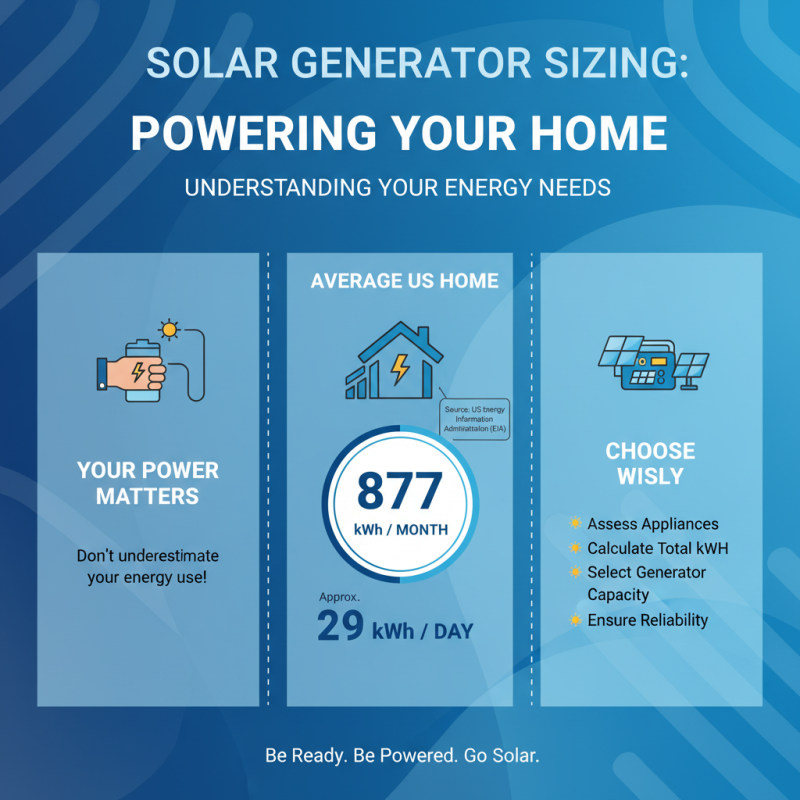
Understanding your power needs is crucial when selecting a solar generator. Many homeowners underestimate their energy consumption. The U.S. Energy Information Administration reported that the average household uses about 877 kWh per month. This translates to approximately 29 kWh per day.
By calculating the wattage of your devices, you can estimate your needs. For instance, a refrigerator may use 150-800 watts, while lights typically consume 10-100 watts. If you plan to power multiple devices, the total wattage can add up quickly. An inefficient choice might leave you without power when you need it most.
Consider peak usage times. It's essential to determine when your power needs are highest. If you want to run several appliances simultaneously, you'll require a generator capable of handling those demands. A common mistake is not factoring in start-up watts for devices with motors. These can be up to three times the running wattage. This often leads to frustration and insufficient power during essential moments.
Types of Solar Generators: Portable vs. Stationary Options
When choosing a solar generator, consider the type that suits your needs.
Portable solar generators are compact and lightweight. They typically range from 100 to 2,000 watts and are ideal for camping or short trips.
Recent data shows that 75% of users prefer portability for convenience.
These generators can easily power small devices like phones and lights.
On the other hand, stationary solar generators provide more power. They can run larger appliances and are often connected to home systems.
With output capabilities reaching over 5,000 watts, they can handle more demanding tasks, such as refrigeration.
However, they require a more significant investment. The average cost of a stationary model can exceed $3,000.
Many individuals may overlook their actual energy needs.
Assessing daily consumption is critical. A common mistake is purchasing a generator that can't handle peak usage.
Data indicates that about 30% of buyers face this issue.
Prioritizing your power requirements can lead to better satisfaction with your choice.
Remember, the right generator enhances energy independence, but it must align with your lifestyle.
Key Features to Consider When Selecting a Solar Generator
When selecting a solar generator for your home, specific features deserve
careful consideration.
Battery capacity is crucial.
A larger capacity means longer runtime. Look for a generator with
at least 1000 watt-hours for basic needs.
Output power is another key aspect. Ensure it can run your essential appliances.
Check wattage ratings before deciding.
Portability can be quite significant. If you plan to use it outdoors,
lightweight models matter. Some generators have wheels for easy transport.
Solar input options also vary.
A generator that supports multiple solar panels can charge faster.
This can be particularly useful during extended outages.
Consider the inverter type too.
Pure sine wave inverters
are better for sensitive devices. Those can prevent damage to electronics.
Noise level
should not be ignored. Some generators are surprisingly quiet, while others can be loud.
Lastly, user-friendly controls can make a difference.
Complicated settings may only confuse. Reflect on what fits your lifestyle best.
Evaluating Battery Capacity and Solar Panel Efficiency
When choosing a solar generator, battery capacity and solar panel efficiency are crucial. A larger battery capacity means you can store more energy. This is especially important during cloudy days or nighttime. Consider how many devices you plan to power. Make sure the generator can meet those demands. A small battery might save money but could leave you in the dark.
Solar panel efficiency plays a big role, too. Panels convert sunlight into energy, and their efficiency impacts how much power you gather. Look for panels that offer high efficiency ratings. These will generate more power even in limited sunlight. But remember, efficiency often comes at a higher cost. Weigh your options carefully. Think about the space available for installations. Less space can limit your choices.
Keep in mind, not all solar generators are perfect. You may face issues like longer charging times or limited output. Some users find themselves needing more power than expected. Reflect on your energy needs before committing. Take time to research and ask questions. A well-informed choice will ultimately lead to a better experience with your solar generator.
Essential Tips for Choosing a Solar Generator for Your House
| Feature |
Description |
Recommended Value |
| Battery Capacity |
Measured in watt-hours (Wh), this indicates how much energy the system can store. |
2000 - 6000 Wh |
| Solar Panel Efficiency |
Refers to the percentage of sunlight converted into usable electricity. |
15% - 22% |
| Portability |
Consider weight and ease of transport if you plan to move the generator frequently. |
Lightweight models under 50 lbs |
| Charging Time |
Time taken to fully charge the battery from solar panels or other sources. |
4 - 8 hours |
| Number of Outlets |
Variety and quantity of ports available for different devices. |
At least 2 AC outlets |
| Warranty |
Coverage for defects and performance over time. |
3 - 5 years |
Budgeting for Your Solar Generator Purchase and Installation
When budgeting for a solar generator, start with the total cost. Consider both the purchase price and installation expenses. Many homeowners overlook installation costs, thinking only about the generator itself. It's crucial to account for wiring, brackets, and labor. This could significantly increase your total expenditure.
Tips: Always get multiple quotes for installation. Prices can vary widely among service providers. Check reviews to ensure you hire a reputable installer. Don't forget ongoing maintenance costs. Solar generators require attention to ensure efficiency.
Evaluate your energy needs realistically. Do you need backup power for essential appliances? Plan for peak usage times. A generator that meets high demands may cost more but could save money long-term. Remember that financial incentives, like tax credits, could lower your expense. Take full advantage of these opportunities.